Saturday, November 1, 2014

Shiver

Shiver

By: Maggie Stiefvater

Stiefvater, M., Stengel, C., & Scholastic Press. (2009). Shiver. New York: Scholastic Press.

Summary and Response:
Shiver is told from alternating points of view of Sam and Grace. Sam is a werewolf who is human during the warmer seasons and shape shifts into a werewolf when the weather is cold. Sam does not want to be a werewolf but has no choice. Grace is a human who was attacked by a pack of wolves when she was younger. Grace in turn instead of being scared of the wolves has developed an affection for the wolves and especially for who she calls "her" wolf, Sam. The two first meet, both as humans, when Sam has been shot and is lying on her back porch. Shiver  details Sam and Grace's relationship and growing love for each other. The only catch is that this is Sam's last season being able to turn back into a human, once it is cold he will stay a wolf forever. I personally did not love this novel. I had to push myself to read each and every page. Sure, there were some sentences and phrases that I liked but as a whole I just could not get into it. It is definitely a fantasy and seems so much like Twilight (and yes I did not like that novel either). This novel is best used with high school students, although some junior high students would be able to read and understand it if they are at a high reading level. 

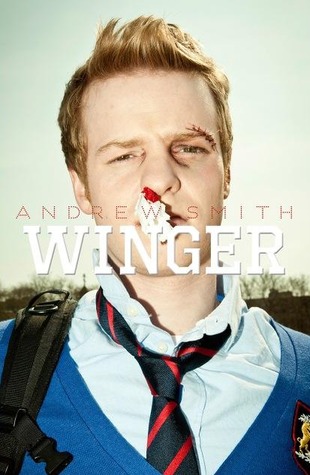
Winger

Winger

By: Andrew Smith

Winger (Winger, #1)
Smith, A. (2013). Winger. New York: Simon & Schuster Books for Young Readers.

Summary and Response:
Winger is centered around the life of a 14 year old boy, Ryan Dean West, who is a genius and in the 11th grade at Pine Mountain Academy. Ryan Dean is one of those characters that just about anyone can relate to whether they see a little of themselves in him or know someone they went to school with that was a Ryan Dean.  He is a fun loving, hilarious, sex crazed, athletic teenager. This novel goes through Ryan's junior year chronicling the everyday events that happen to him. Due to a small theft, Ryan is spending his time in Opportunity Hall, a dorm for the "behavioral challenges" at the school. Ryan is trying desperately to fit in and not be seen as the little kid anymore. Through his dying love and affection for his best friend Annie, rooming with the typical dumb jock, and becoming friends with the out of the closet gay kid, Ryan has moments of ups and downs.  Winger takes you on an emotional journey and all of the characters reactions, especially at the end when Joey (the gay kid) is brutally beaten to death are so real and palpable. A great follow up read from this novel could be Jumping Off Swings by Jo Knowles.

MidwinterBlood

MidwinterBlood

By: Marcus Sedgwick
Sedgwick, M. (2013). Midwinterblood. New York: Roaring Brook Press.

2014 Winner if the Printz Award

Note: This award is given to a  book that exemplifies literary excellence in young adult literature.


Summary: This is a complex interwoven tale of a man and woman who are connected deeply.  The story begins in 2073 when a journalist, Eric Seven goes to the island of Blessed.  Here he meets Merle, a woman he is sure he has met before.  The island is beautiful but strange.  No one ages and there are no children.  As you work your way through the story you are working backwards.  You see Eric and Merle unite as mother and son, artist and friend, lovers, and even siblings.  You are eventually taken all the way back to the 10th century.  All the tales are inter weaved with the present Eric and Merle, who are destined to be together and die together for the seventh time.  


If you enjoy MidwinterBlood, check out these books!


Eleanor & Park


Eleanor & Park
By: Rainbow Rowell
Rowell, R. (2013). Eleanor & park. London: Orion Books.

2014 Printz Award Honor Book

Note: This award is given to a book that exemplifies literary excellence in young adult literature. 

Summary: It is 1986 in Omaha.  Park is a half Korean teenage boy who has a good life.  Eleanor is new and doesn't quite fit in.  Eleanor rides the bus and Park reluctantly lets her sit next to him.  As the days go on they soon realize they have a lot in common and their relationship turns into a friendship and then into love.  Park helps Eleanor through her life.  He does not save her specifically but helps give her strength to make it through her awful home life of abuse, neglect, poverty, and her step-father.  The end of this story is somewhat misleading.  You do not truly know what happens between Eleanor and Park.  You do hope for the best and are crossing your fingers that they come together again.

Check out the titles below for more Young Adult Fiction you should love if Eleanor and Park was a favorite of yours. 


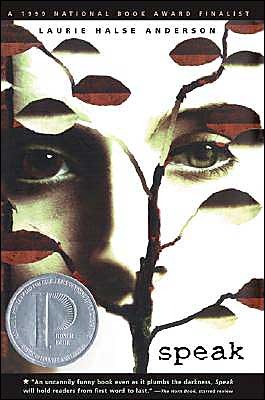
Speak

Speak

By: Laurie Halse Anderson

Speak
Anderson, L. H. (1999). Speak. New York: Farrar Straus Giroux.

Summary and Response:
In this startling and hard hitting novel, Melinda is beginning 9th grade and has become a self selected mute. Other students think she is weird and her parents and teachers are seeing this as a sign of delinquency. We soon find out that Melinda has become silent due to a party she attended over the summer where she was raped. Melinda called the cops and they busted the party but she fled before explaining why she called the police. Through the school year Melinda struggles with what has happened to her. She finds an outlet in her art class as she figures out how to draw trees and through a boy she meets in science class. Melinda finally begins to overcome the trauma of her rape as she tries to help an ex best friend get away from the same boy who raped her. Because of the subject matter, this novel would best be suited for your high school level students. I can see this novel being used as a basis for beginning a research unit on sexual crimes.

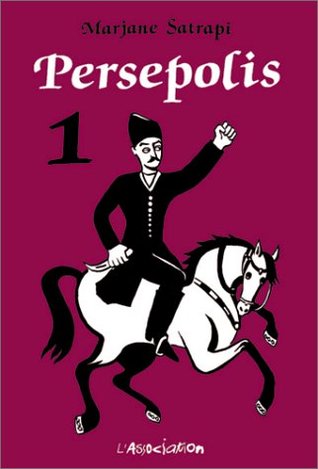
Persepolis

Persepolis

By: Marjane Satrapi


Persepolis, Volume 1 (Persepolis, #1)
Satrapi, M. (2003). Persepolis. New York, NY: Pantheon Books.

Summary and Response:
This graphic novel is truly two stories in one. We follow young Marjane Satrapi from the age of 6 to 14 as she tries to figure herself out through clothing, music, and her voice. She is considered a rebel and always testing the world and society around her. As we see her begin to grow up, we are told about the environment she is enduring. The Islamic Revolution is happening in Iran at this time and she is often surrounded by bombings and fundamentalist power. The two are intertwined wonderfully through the black and white drawings. They are comic strip style and bring forth the emotion, the strife, and the social consequences. By the end of the novel Marjane's parents decide to send her to Austria alone to have a better life and education. It definitely makes you want to read the next installment to see where life takes her next. This would be a great book to discuss the impact our societies can have on our own identities and growth.


The Knife of Never Letting Go

The Knife of Never Letting Go

By: Patrick Ness

Ness, P. (2008). The knife of never letting go. Boston, MA: Candlewick Press.

Summary and Response:

Told in first person stream of consciousness, we are taken into Todd's life as he is on the verge of becoming a man. We learn that years ago an alien race called Spackle killed off all the woman in  Prentisstown and left the men with "The Noise" germ. this means that every man can hear each others thoughts, so there are no secrets. We see that most often these thoughts are deceitful and vengeful. One day Todd and his faithful dog Manchee go out to the swamp and find a spot where "The Noise" is gone. Upon finding this Todd has to leave the town for he is in danger now. Todd ends up meeting the first woman he has ever seen, Viola. Together they journey from town to town trying to stay safe but the army (the men from Prentisstown) keep coming and slaughtering everyone. Eventually Manshee is killed and Todd has to carry a dying Viola to the town of Haven. The novel ends on a huge cliffhanger and is part of what makes this novel an excellent read. Because of the stream of consciousness, a lot of Todd's thoughts are grammatically incorrect. It would be great to use these portions to review revising and editing rules. It is also a great story to make predictions on what will happen in the next book using textual evidence for support.